A general contractor management fee in Pasadena, CA typically runs 10% to 20% of your total project cost, covering the labor of running the job rather than the materials or trade work itself. That percentage tends to climb past 20% on historic home renovations inside one of Pasadena's landmark districts, where extra design review adds hours a standard remodel never sees. Here's what that fee actually buys, how local contractors structure it, and how to spot a bid that's hiding costs instead of explaining them.
How Much Is a General Contractor Management Fee in Pasadena?
The fee size usually moves in the opposite direction of project size. Fixed overhead costs (insurance, licensing, office staff) don't shrink just because the job is smaller, so a $50,000 bathroom remodel often carries a higher percentage than a $400,000 addition.
Here's roughly how that plays out across common Pasadena project sizes:
| Project Size | Typical Fee Range | Example Fee |
|---|---|---|
| Small remodel ($25K-$75K) | 15-20% | $3,750-$15,000 |
| Mid-size remodel ($75K-$200K) | 12-18% | $9,000-$36,000 |
| Whole-home renovation or addition ($200K-$500K) | 10-15% | $20,000-$75,000 |
| Custom home build ($500K+) | 8-15% | $40,000+ |
These are planning ranges, not quotes. Your actual fee depends on scope definition, how many trades are involved, and which pricing structure your contractor uses. If you're weighing options across the broader region, our guide on general contractor percentage in Los Angeles County breaks down how that split compares county-wide.
What a General Contractor's Fee Actually Includes
A general contractor fee isn't a markup tacked onto lumber and tile. It's the charge for managing the project itself.
That includes:
- Project planning and scheduling
- Hiring and supervising subcontractors
- Pulling permits and coordinating inspections
- Managing material deliveries and site logistics
- Daily on-site oversight and quality checks
- Keeping you updated as the job moves
Without that layer, a remodel is just a pile of disconnected trades showing up on their own schedule. Licensing matters here too. California requires anyone performing construction work valued at $500 or more in combined labor and materials to hold a CSLB license, and that license is what legally entitles a contractor to collect a management fee in the first place. You can review the full rule in CSLB's official licensing guide, which confirms any construction project valued at $500 or more in labor and materials combined must be performed by a state-licensed contractor .
If you want to see what full-service general contracting looks like in practice, our general contractor services page outlines the scope our team handles on Pasadena-area projects.
Fee Structures: How Pasadena Contractors Charge
Nearly every residential GC contract uses one of four pricing approaches. Which one fits your project depends on how locked-down the scope is before anyone picks up a tool.
Typical Fee Structures at a Glance
| Fee Structure | Typical Rate | Best For | Example on a $200K Remodel |
|---|---|---|---|
| Percentage fee | 10-20% of total project cost | Projects with evolving scope | $20,000-$40,000 |
| Hourly rate | $75-$150/hour | Small jobs or consulting-style oversight | $3,000-$9,000 (40-60 hours) |
| Fixed-price | Flat dollar figure set in advance | Fully defined scope, standard builds | Around $25,000 |
| Flat fee | Set amount regardless of final cost | Simple additions, single-room remodels | $8,000-$15,000 |
Percentage of Total Project Cost
The percentage fee is the most common structure in Pasadena, landing between 10% and 20% of total project cost. Smaller jobs typically sit near the top of that range since fixed overhead doesn't scale down with the job.
Cost-Plus vs. Fixed-Price: How Each Works
A cost-plus contract shows every line-item cost plus an agreed-upon fee on top. It's transparent, but open-ended if the scope grows mid-project.
A fixed-price contract sets one guaranteed number. The contractor absorbs the risk of overruns, which usually means a slightly higher quote upfront to cover that risk.
For an older Pasadena home where hidden issues are likely (outdated wiring, old plumbing behind plaster walls), cost-plus can make more sense. For a well-defined new build, fixed-price offers more budget certainty. If you go cost-plus, insist on a guaranteed maximum price (GMP) cap so billing can't run indefinitely.
Factors That Push Your Fee Up or Down
The 10-20% range is wide because complexity, scope definition, and project type all move the actual number.
Project Complexity and Pasadena's Permitting Layers
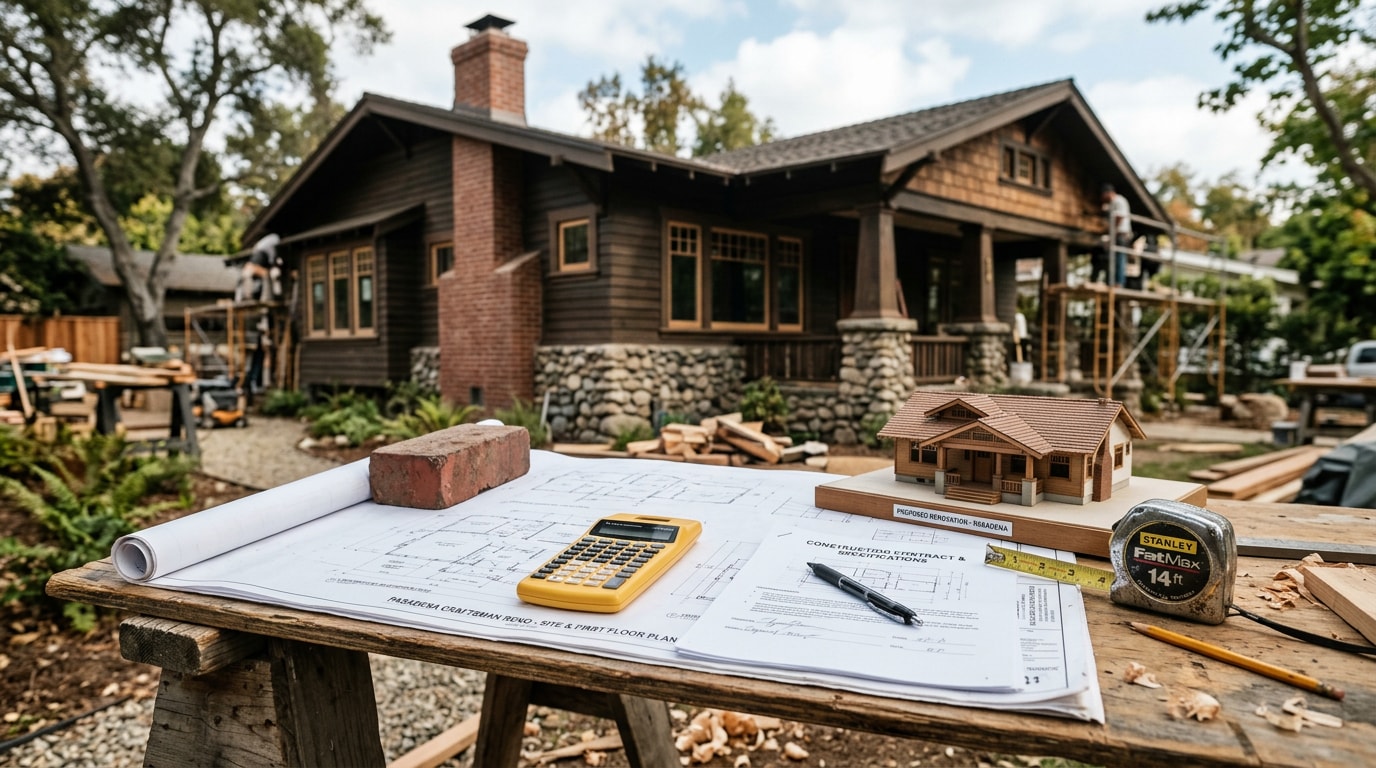
Structural changes, custom finishes, and mechanical work all increase the oversight a project needs, which raises the fee. Pasadena adds its own wrinkle on top of that: the city maintains dozens of landmark and historic districts, and exterior alterations visible from the street and new construction within these districts require a Certificate of Appropriateness before a building permit can be issued . That extra review step means a historic home project typically needs more hands-on project management than a standard renovation, and the fee usually reflects it.
If your project is a broader home renovation rather than a historic restoration, our home renovation services page walks through what's typically involved.
Kitchen vs. Whole-Home Remodels: Does the Percentage Change?
The percentage itself usually stays in the same 10-20% band whether you're doing a kitchen or a whole-home renovation. What changes is the dollar amount. Kitchens and bathrooms pack more trades (plumbing, electrical, cabinetry, tile) into a small footprint, so the fee can feel disproportionately high relative to square footage even at a standard rate.
See our kitchen remodeling services for typical Pasadena project ranges by scope.
What That Fee Actually Pays For
The 10-20% figure covers real, ongoing business costs. It isn't pure profit sitting on top of your bill.
That fee funds:
- General liability insurance and bonding
- Project-management software and admin time
- Warranty reserves for work after completion
- Legal and compliance costs tied to running a licensed business
- The salary of whoever is actually managing your job day to day
These overhead costs exist whether a contractor has one job running or five. For context on where that money goes industry-wide, NAHB's 2024 Cost of Constructing a Home survey found overhead and general expenses accounted for 5.7% of a new home's final sale price, with builder profit averaging 11.0% . A remodeling management fee works differently from new-home pricing, but the same principle holds: skilled project-management time is a real, ongoing cost, not padding.
How to Compare Contractor Bids
Once you understand what the fee covers, comparing bids becomes less about chasing the lowest number and more about comparing apples to apples. A bid that's dramatically lower than the rest usually means something is missing from the scope, not that you found a deal.
Watch for these red flags before you sign:
- Requests for large upfront payments
- Verbal-only estimates with nothing in writing
- Bids well below competitors with no clear explanation
- Vague scope language that leaves room for change orders later
- No mention of how the fee is calculated at all
Any of these should prompt more questions before you commit. Our team at Builders Pathway has walked Pasadena homeowners through dozens of bid comparisons, and the pattern holds every time: the contractor who explains their fee structure line by line is almost always the one who finishes on budget. If you're ready to start comparing quotes on your own project, reach out for a free estimate and we'll walk through the numbers with you.
Builders Pathway works on general contracting, kitchen, bathroom, and custom home projects throughout Pasadena, CA and the surrounding San Gabriel Valley. You can see examples of recent work on our projects page or learn more about our full range of services from the Builders Pathway homepage.
FAQ
How Much Does a General Contractor Cost in Pasadena?
A general contractor in Pasadena typically charges 10% to 20% of total project cost as their management fee. On a $150,000 kitchen and bathroom remodel, that works out to roughly $15,000 to $30,000, depending on complexity and which contract type is used.
Is It Cheaper to Be My Own General Contractor?
Acting as your own general contractor can save the 10-20% fee, but you take on the scheduling, liability, and mistake risk a GC normally manages. For straightforward projects some homeowners manage it successfully. For complex or historic renovations, self-managing a remodel often costs more in delays and errors than it saves.
What Is a Typical Markup for a General Contractor?
Markup and fee are often used interchangeably, though markup specifically refers to the amount added above direct costs. A typical contractor markup runs 10-20%, with complex or custom jobs sometimes pushing past 25%.
What Is a Reasonable Overhead and Profit Split for a Contractor?
There's no single fixed split, since it depends heavily on company size and project type. Nationally, overhead and general expenses have run around 5.7% of a home's sale price, with builder profit closer to 11%, though remodeling projects carry a different cost structure than new construction.
Does the Fee Change if the Project Goes Over Budget?
On a percentage fee, yes: the fee grows with the final project cost, since it's calculated as a share of the total. On a fixed-price or flat-fee contract, the fee stays the same even if costs run over, which is why those structures usually come in with a slightly higher starting quote.
How Much Should You Pay a Contractor Upfront?
California law caps the down payment on a home improvement contract at $1,000 or 10% of the contract price, whichever is less, under state rules enforced by the Contractors State License Board, which states the down payment cannot be more than $1,000 or 10 percent of the contract price, whichever is less, for a home improvement job . Any contractor asking for significantly more upfront is worth questioning before you sign.