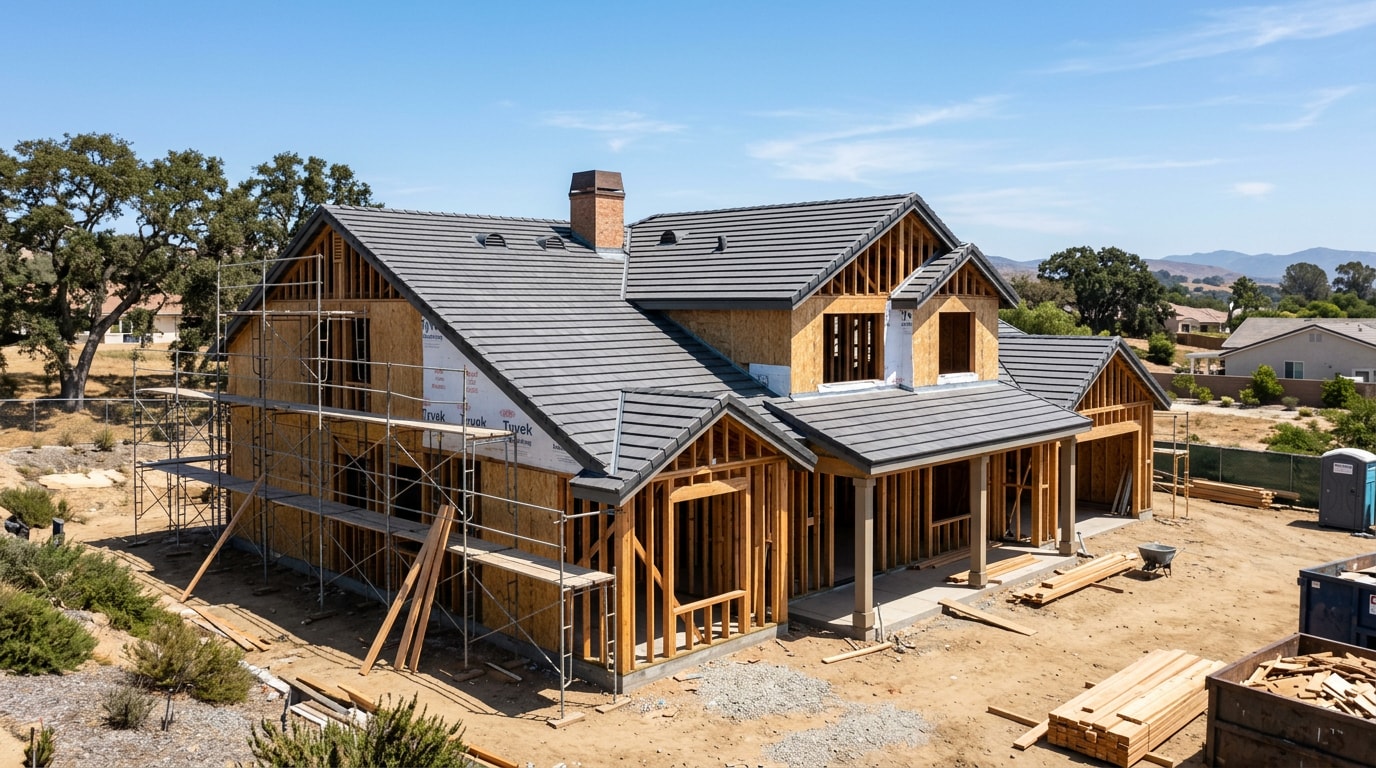
A new construction roofer in Orange County, CA handles something fundamentally different from a reroof crew: a bare deck, a live build schedule, and a 2026 code environment that just changed twice. If you're a builder sequencing trades or a homeowner watching your custom build take shape, the roof is one of the few systems inspectors, insurers, and HOAs will all scrutinize before you ever move in. Here's what the job actually involves, what changed on January 1, 2026, and what to ask before you hire.
New Construction Roofing vs. Roof Replacement: Why the Distinction Matters
New construction roofing means designing and installing a complete system on a brand-new deck, built into the original construction sequence rather than bolted on afterward.
A replacement, by contrast, works around a structure that already exists, often with tear-off decisions, matching constraints, and a roof that's aged into failure. New construction roofers coordinate with framers and inspectors before the first course ever goes down. Reroofing contractors start with a finished building and someone else's old decisions.
That difference shows up in scheduling, too. A roofer brought in at the framing stage has to track the rest of the build, not just the weather. If you're comparing a new build against a renovation path, our general contracting services page breaks down how trades sequence on each.
Services a New Construction Roofing Partner Should Coordinate
A roofer focused on new builds does more than show up and nail shingles. The scope usually includes:
- Material and system selection based on roof slope, budget, and climate zone
- Schedule coordination with framing, electrical rough-in, and HVAC penetrations
- Dry-in protection once the deck is framed, to shield the structure before the rest of the build closes it in
- Flashing and drainage design, especially on the flat or low-slope sections common in mixed residential-commercial OC projects
- Permit documentation and inspection sign-off that ties back to the building department's final
This applies whether you're building a single tract home or a larger commercial project. Builders handling the earlier site phases can see how that coordination starts on our site preparation page.
Roofing Materials for New Builds in Orange County's Climate
Material choice comes down to three things: budget, roof slope, and how much UV and heat the structure will absorb. Orange County sits mostly in California climate zones 6 (coastal) and 8 (inland), Orange County — Zones 6 (coastal) and 8 (inland) , which affects both material performance and Title 24 compliance paperwork.
| Material | Typical Use | Climate Performance in OC | Install Timeline |
|---|---|---|---|
| Asphalt shingle | Single-family tract homes | Lower cost, moderate UV resistance | Fastest to install |
| Concrete or clay tile | Custom homes, HOA-governed communities | High thermal mass, holds up well against sustained heat | Longest install due to weight and battens |
| Metal (standing seam) | Modern custom builds, ADUs | Strong reflectivity, long service life | Moderate |
| TPO / PVC / membrane | Flat or low-slope commercial, ADU roofs | Heat-welded seams, strong cool-roof compliance | Moderate, weather-dependent |
Tile's thermal mass is a real advantage in OC's hot inland valleys, which is one reason it remains common on new custom builds despite the added weight and cost. If you're planning a ground-up custom home, our custom home building page covers how roof system selection fits into the broader design process.
What Changed in 2026: Title 24 and the New Wildland-Urban Interface Code
This is the part most roofing service pages skip, and it's the single biggest compliance shift new construction roofers in Orange County are dealing with right now.
Title 24 Part 6 (Energy Code). The 2025 Building Energy Efficiency Standards will go into effect January 1, 2026 , and any permit application submitted on or after that date has to comply with the new cycle. For roofing specifically, Title 24 sets cool-roof requirements: your new roof must meet minimum solar reflectance values (typically 0.20-0.63) and thermal emittance standards (usually 0.75 or higher) depending on your roof slope and material type .
Title 24 Part 7 (Wildland-Urban Interface Code). This is new. As of January 1, 2026, those requirements live in the new California Wildland-Urban Interface Code (CWUIC) — Title 24 Part 7 — which consolidated the previous Chapter 7A standards into a single, updated code . If your lot sits in a designated Fire Hazard Severity Zone, your roofer needs to build to Class A assemblies, ember-resistant vents, and noncombustible flashing, not just the standard assembly. Ember-resistant vents, Class A assemblies, and noncombustible flashing typically add $2,000–$5,000 to a standard project , so it's worth asking upfront whether your parcel falls inside a fire zone.
HOA review. Most OC homes, about 85%, sit inside an HOA with its own architectural review process . That review happens separately from the building department, and it can add weeks if your roof material or color isn't pre-approved. Confirm this before you order materials, not after.
Your contractor should hand you CRRC product documentation and Title 24 compliance forms with the permit package, not after the fact. The Cool Roof Rating Council is a nonprofit organization that develops accurate and credible methods for evaluating and labeling the radiative properties of roofing products , and its ratings are what inspectors check against during plan review.
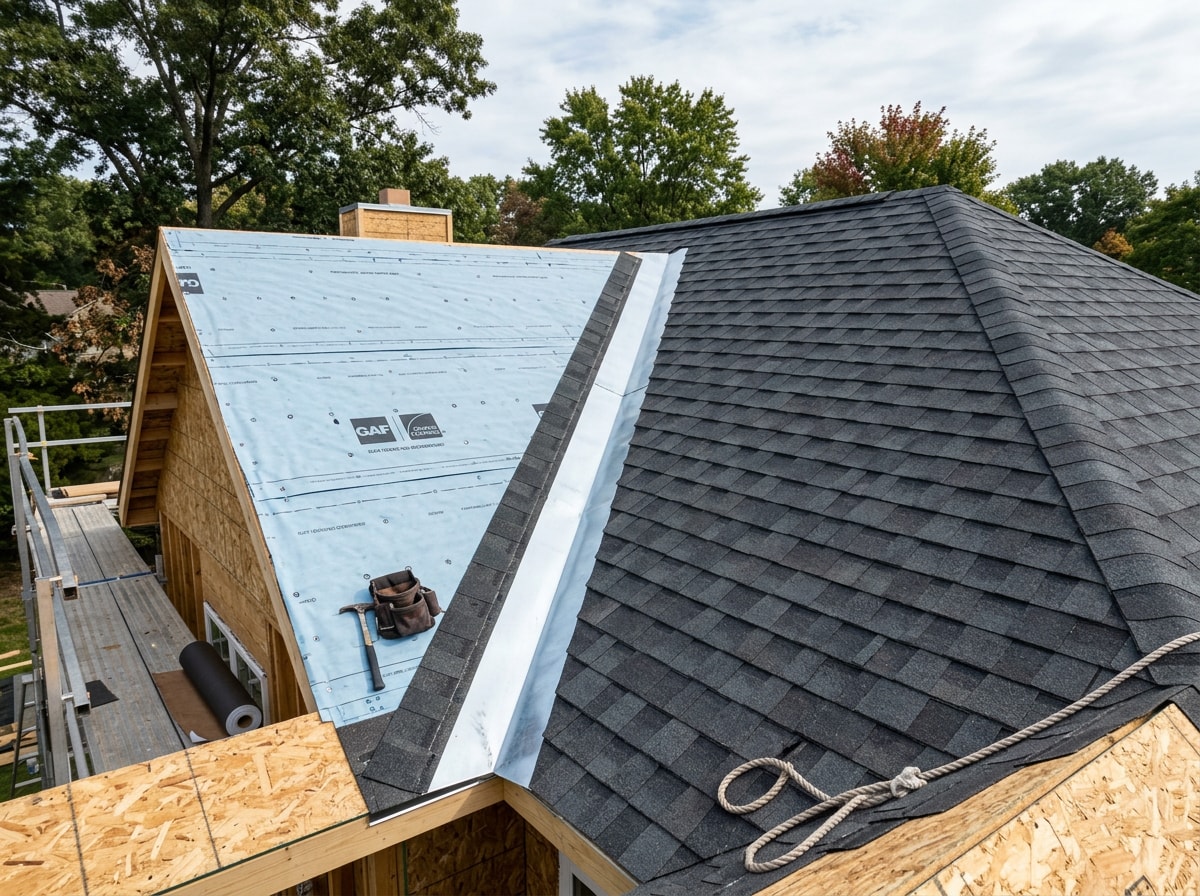
Step by Step: What Happens During Installation
Installation on a new build generally follows the same sequence regardless of material:
- Deck inspection — framers hand off a finished deck that gets checked for proper sheathing and nailing before anything goes on top.
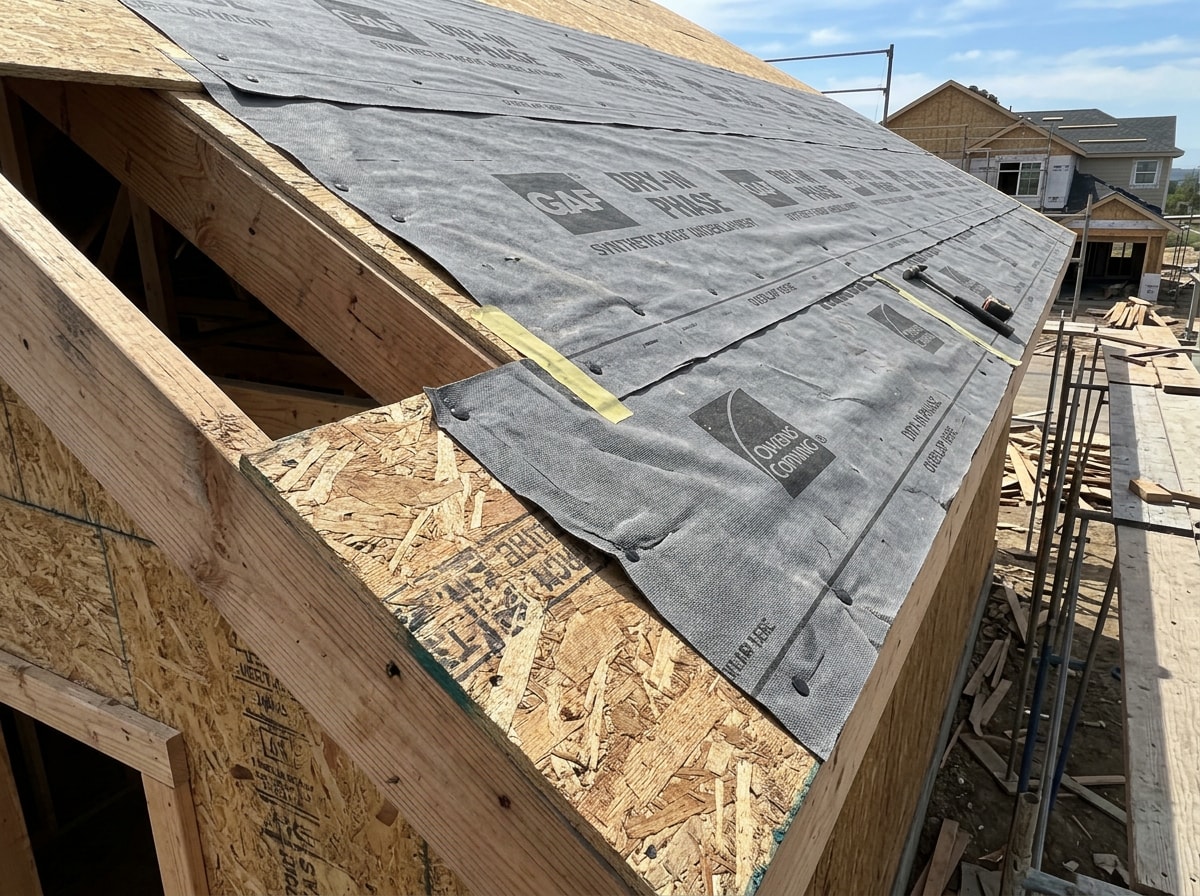
- Underlayment — a secondary water barrier is installed in overlapping layers across the entire deck.
- Valley and flashing reinforcement — valleys get extra protection since they concentrate runoff from multiple roof planes.
- Material installation — shingles, tile, metal panels, or membrane go down, with flashing integrated into each course as it's laid, not patched on afterward.
- Fastener verification — inspectors check spacing and attachment patterns, particularly in designated high-wind areas.
- Final inspection and documentation — the building department signs off, and the contractor delivers warranty paperwork.
Timeline shifts by material. On a standard single-family home, asphalt shingle installs typically run four to five days versus nine to ten days for tile , mainly because of the batten setup and weight distribution tile requires. That gap matters if your framing crew is waiting on a dried-in roof to start interior work.
How to Vet a New Construction Roofer Before You Sign
A few checks before you commit to a contractor:
- Verify the license directly with CSLB. California requires anyone contracting for work over $500 to carry an active license, and
anyone who contracts for construction work valued at $500 or more (labor plus materials) must hold a license from the Contractors State License Board . Roofing typically falls under the C-39 classification, and you can confirm status, bond, and complaint history on the CSLB's license lookup tool.
- Confirm bond and insurance.
Every active California contractor must carry a $25,000 contractor license bond. Ask for proof, don't just take their word for it.
- Ask who pulls the permit. On a new build, roofing permits are often part of the master building permit. Confirm whether your roofer is working under the general contractor's permit or pulling a separate one.
- Get the Title 24 and WUI documentation in writing before materials are ordered, especially if your lot is in a fire hazard zone or an HOA community.
- Ask for CRRC product data sheets on whatever material they're proposing, not just a verbal assurance it's "code compliant."
For flashing, edge metal, and drainage design, reputable contractors follow published guidance from the National Roofing Contractors Association, a nonprofit association that represents all segments of the roofing industry including contractors, manufacturers, architects, and government agencies . If your roofer can't speak to NRCA-aligned flashing details on a low-slope section, that's worth a follow-up question.
If you want a crew that's already coordinating roofing with the rest of the build, from framing through final inspection, see our general contractor services or browse completed work on our projects page. You can also read our dedicated breakdown of roofing options for Orange County homeowners for more on repair versus replacement scenarios.
On our own new-build projects across Orange County, the scheduling conflict we see most often isn't the roofing work itself, it's HOA material approval lagging behind the framing timeline. Builders who submit tile or color samples for HOA review before the deck is even framed avoid the multi-week gap that stalls everyone else.
Ready to get your roof scoped against the current code? Request a free estimate and we'll walk through material options, Title 24 and WUI requirements for your specific parcel, and a realistic install window tied to your framing schedule.
FAQ
What's the difference between a new construction roofer and a reroofing contractor?
A new construction roofer installs a complete system on a bare, newly framed deck as part of the original build sequence. A reroofing contractor works around an existing structure, often removing old material first. The skills overlap, but the scheduling, inspection points, and code triggers differ.
Do I need a permit for a roof on a brand-new home in Orange County?
Yes. Roofing on new construction is typically covered under the master building permit for the project, with its own inspection points for deck, underlayment, and final sign-off. Confirm with your general contractor whether roofing is on a separate permit or rolled into the main one.
What roofing material holds up best in Orange County's climate?
Asphalt shingle is the lower-cost option with moderate UV resistance. Tile offers stronger thermal mass and holds up well in inland heat but costs more and takes longer to install. Metal and membrane systems perform well on modern and flat-roof builds. The right choice depends on budget, HOA rules, and how long you plan to own the home.
How does the 2026 Title 24 and Wildland-Urban Interface code affect my roof?
Title 24 Part 6 sets cool-roof reflectance and emittance minimums that took effect January 1, 2026. If your property sits in a designated Fire Hazard Severity Zone, Title 24 Part 7 (the new Wildland-Urban Interface Code) also applies, requiring Class A assemblies, ember-resistant vents, and noncombustible flashing. Ask your contractor to confirm which zone your parcel falls into before materials are ordered.
How long does it take to install a roof on a new home?
On a standard single-family home, asphalt shingle installation typically runs four to five days, while tile runs closer to nine to ten days due to the added weight and batten setup. Commercial and larger custom projects take longer depending on roof complexity.
How do I verify a roofer's license in California?
Use the CSLB's online license check tool at cslb.ca.gov and search by business name or license number. Confirm the license is active, the classification matches roofing work (typically C-39), and the bond and workers' compensation are current before signing anything.
What's the expected lifespan of a new roofing system?
Lifespan depends on the material and maintenance. Properly installed and maintained systems commonly last two to three decades, with tile and metal generally outlasting asphalt shingle when installed to spec.
How quickly can a new construction roofer start my project?
Start dates depend on project scope, material lead times, and where you are in the framing schedule. Mobilization typically happens within a few weeks once design details, permits, and HOA approvals (if applicable) are finalized.
Builders Pathway coordinates roofing with the rest of the build across Orange County, Los Angeles County, and surrounding areas. See our full Orange County service area or visit the homepage to see our full scope of work.